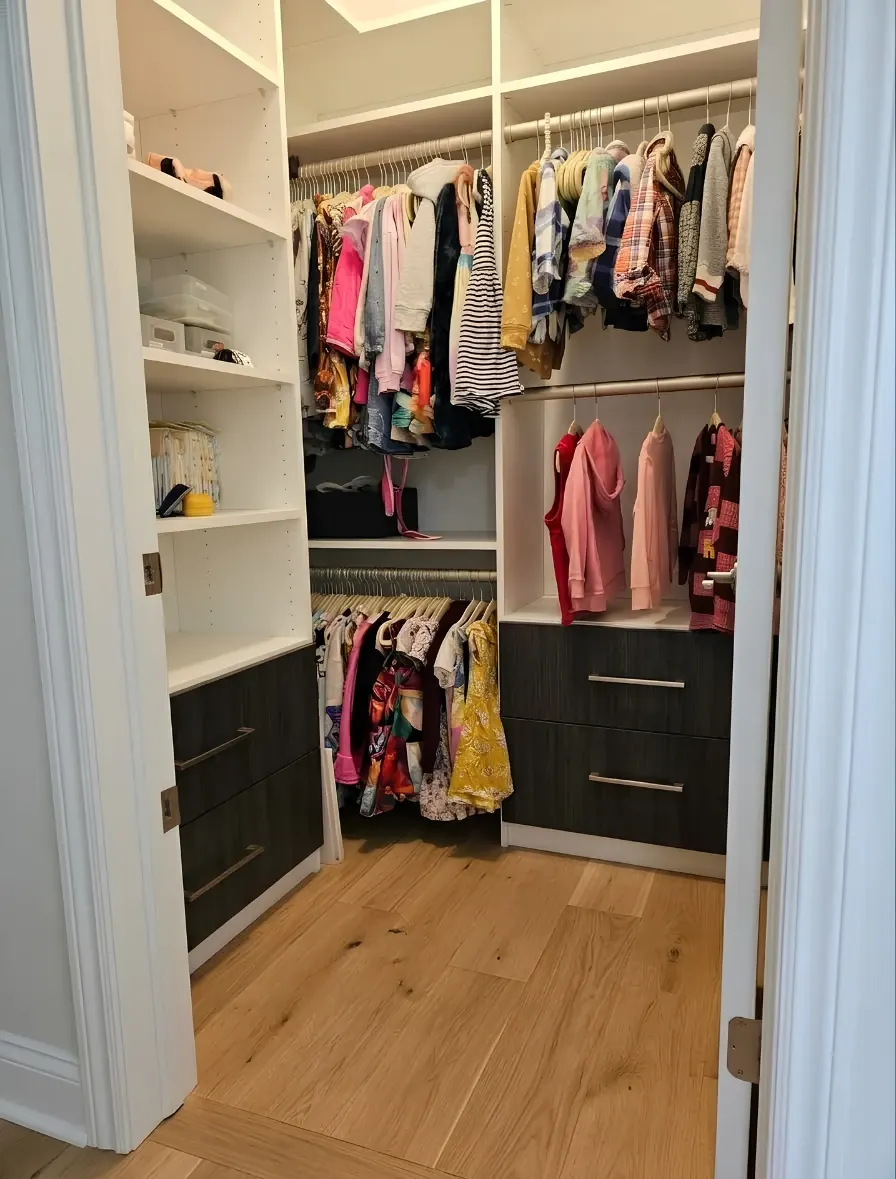
A good kids’ closet works at their height today and still works in five years. The way to get there is to build it in stages: hanging they can reach, drawers they can open, shelves that can be re-spaced as they grow, and a finish that survives being a kids’ closet. Here is how to plan one, room by room and age by age.
Most children’s closets in Toronto homes are a reach-in or a small walk-in. Both can be built to the room, and both are priced below, using the same figures as our closet cost guide.
Plan for the stage they are in, and the next one
| Stage | What kids need | What to build in |
|---|---|---|
| Toddler and preschool (up to 4) | Parents do the dressing; the closet holds a lot of small things | Double hanging, adjustable shelves for bins, a drawer bank, a high shelf for out-of-season clothes |
| School age (5 to 11) | Starting to choose and fetch their own clothes | A low rod they can reach, drawers at their height, open shelves with baskets for sports gear and shoes |
| Teens (12 and up) | Longer clothes, more shoes, more privacy | Full-length hanging, taller shelving, deeper drawers and a place for a bag or a backpack |
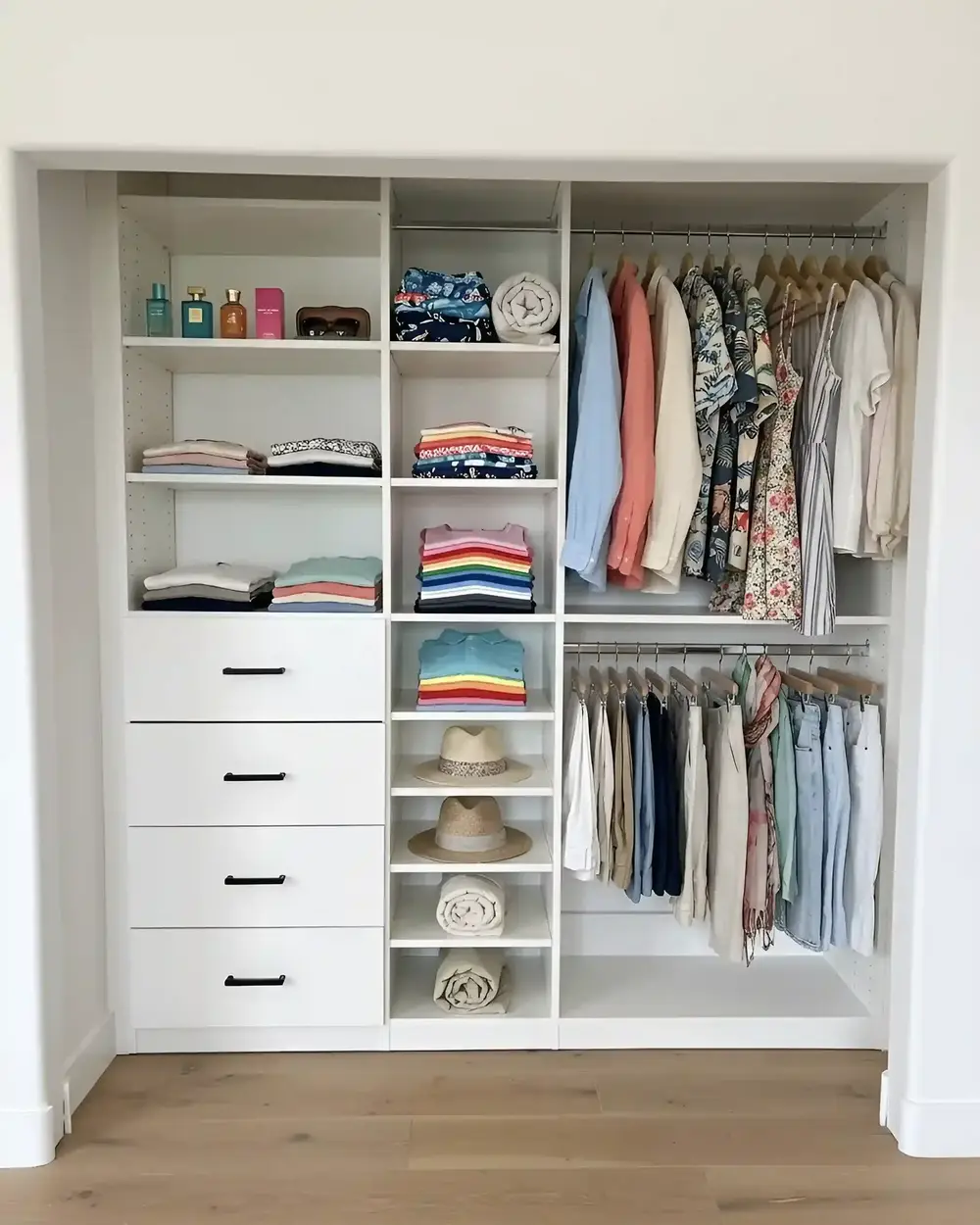
The closet pictured at the top of this page does this well. Two levels of hanging on the right and the back wall give small clothes their own rods, adjustable shelves on the left hold bins and keepsakes, and a drawer bank sits at the base where a child can reach it.
Seven ideas that work in a kids’ closet
1. Hang at two levels
Children’s clothes are short, so a single full-height rod wastes most of the closet. Two rods, one above the other, roughly double the hanging space in the same width. In the closet at the top of this page the upper rod holds jackets and shirts and the lower one holds dresses and hoodies.
2. Put drawers where they can reach
A drawer bank at floor level is the simplest way to let a child dress themselves. Pyjamas, socks and underwear go in the bottom drawers, school clothes above. A four-drawer bank on soft-close undermount runners is typically $600 to $1,200 depending on width and front, and soft-close matters here, because it stops slammed drawers and pinched fingers.
3. Use adjustable shelving
A shelf that sits where you put it, and can move, is what makes a closet last. Bins for toys sit low at three, backpacks and sports gear at eight, and the same shelves carry books and shoes at fourteen. Fixed shelves cannot do that.
4. Give shoes and small things a home
Shoes on the floor of a closet are lost within a week. A low shelf or a pair of baskets gives every pair a place, and a few labelled bins keep hats, mittens and hair accessories from ending up everywhere.
5. Keep the top shelf for what they do not need every day
Out-of-season clothes, hand-me-downs waiting for a younger sibling and keepsakes belong up high, out of the way but still in the closet. Everything a child uses daily stays below shoulder height.
6. Choose a finish that survives
Melamine and laminate are the practical choice: durable, easy to wipe down and available in many colours. A darker drawer front, as in the photo, hides fingerprints better than white. Our materials and hardware page shows the finishes.
7. Light it
A closet a child can see into is one they keep tidier. LED lighting is typically $200 to $600 for a closet, depending on the run length and whether it is switched or sensor-triggered, and a sensor means the light comes on when the door opens, with no switch to reach.
Shared rooms
When two children share a room, split the closet into two zones, each with its own hanging, drawers and shelves, so neither is hunting through the other’s things. Matching zones also stop arguments about who has more space. If you are planning for two, tell us the ages and we will draw it with the stages in mind.
What a kids’ closet costs in Toronto
| Closet | Typical installed price |
|---|---|
| Essential system, compact four-foot reach-in | $1,200 – $2,500 |
| Five to six foot reach-in with a full drawer tower and accessories | $2,500 – $4,000 |
| Seven to eight foot reach-in, or a dual configuration for two children | $4,000 – $6,500 |
| Small walk-in, roughly 6×8 to 8×8 feet | $2,500 – $8,000 |
Prices come from your measurements: the main driver is linear feet of cabinetry, plus drawers, fronts and accessories. Our walk-in closet cost guide explains what moves the number, and our closet organization tips cover the habits that keep it tidy.
Book a free design visit
We measure the room, draw it in 3D and give you an itemised price, with no deposit and no obligation. Tell us the ages and how many children will use the closet, and we will plan it for now and for the next stage. Book the visit here.
Plan Your Kids’ Closet — Book a Free Consultation
Call or Text: (647) 561-9874
Email: info@closetform.ca
Book Online: Free Consultation
Proudly Serving All Toronto & GTA Neighborhoods
Questions
Frequently asked questions
Hang at two levels so small clothes get their own rods, put drawers at floor level where a child can reach them, use adjustable shelves with bins for toys and shoes, and keep out-of-season clothes on the top shelf.
A compact four-foot reach-in starts around $1,200 and runs to $2,500. A five to six foot reach-in with a drawer tower is $2,500 to $4,000, and a larger or dual closet is $4,000 to $6,500. A small walk-in is typically $2,500 to $8,000.
It depends on the child and the age. A lower rod they can reach suits school age, and a second rod above holds what an adult reaches for. We measure with you and set the heights to fit.
Yes. We split it into two zones, each with its own hanging, drawers and shelves, so each child has their own space inside one closet.
Melamine or laminate. It is durable, easy to wipe down and comes in many colours, and a darker drawer front hides fingerprints better than white.
Yes. The in-home visit takes thirty to forty-five minutes and includes laser measurements, a 3D design and an itemised price, with no deposit and no obligation.