
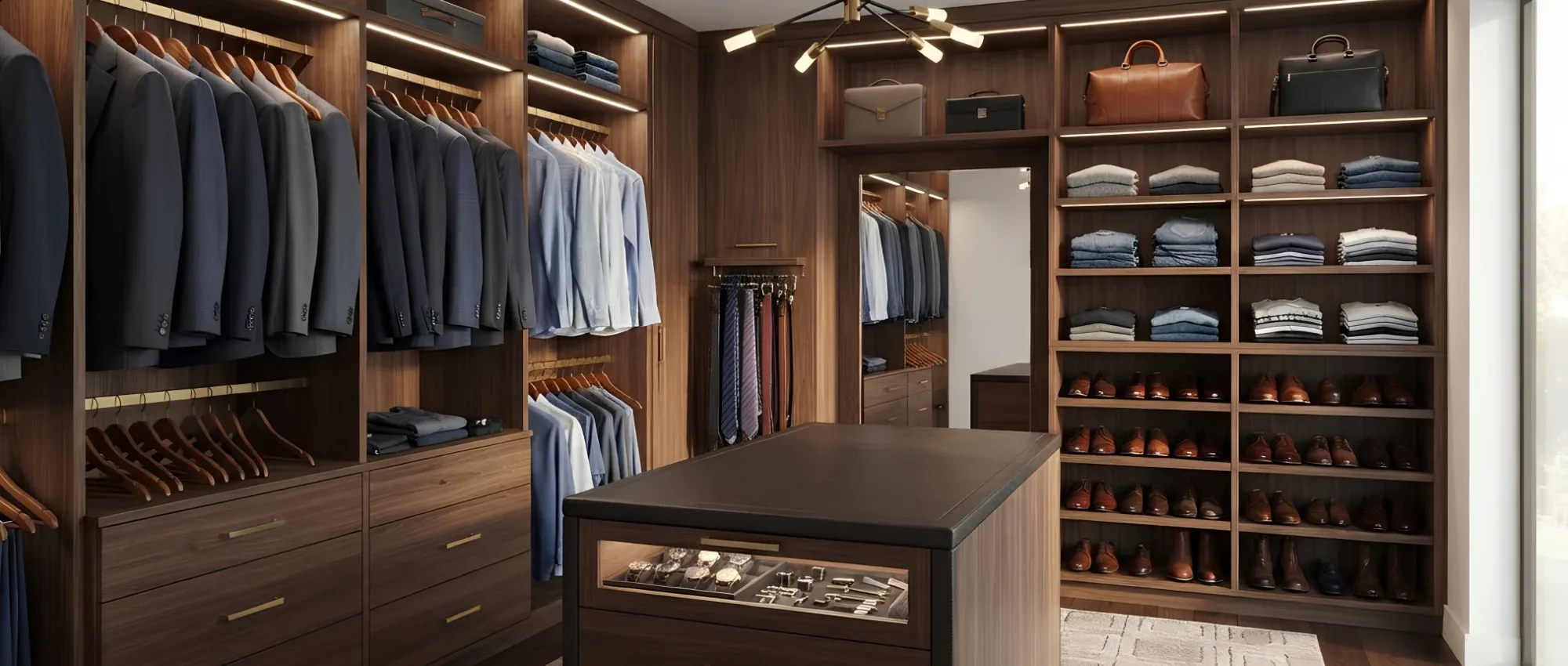
Closet Accessories & Organizers in Toronto
Fifteen fittings, inside the cabinetry and on the face of it — what each one does, where it earns its place, and why every one of them is its own line on your quote.
Overview
What goes inside a custom closet
The cabinetry is the box. The accessories are what make the box do something — and they are the part of a closet quote that varies most between two companies, because they are the part that is easiest to leave off a drawing and sell you afterwards.
Priced on its own line
Every fitting is quoted separately on your 3D design, so you can see what each one costs and take it out in front of the designer rather than by email a week later. Nothing is bundled, and nothing appears after the deposit.
None of it is necessary
A closet with good hanging, adjustable shelving and a drawer bank works. Accessories are for the things with no natural home — ties, belts, jewellery, the shoes in a heap by the door — and giving each one a place is most of the difference between tidy for a fortnight and tidy.
Fitted, not added
Each item is drawn into the elevation before anything is cut, so the bay is sized around it: a trouser rack needs its depth, a hamper its door swing, lit glass shelving a cable route. Retro-fitting the same item into a finished closet usually costs a shelf.
The catalogue
Every accessory we fit
Grouped by what they do rather than by room, because almost nobody arrives looking for an accessory — they arrive looking for somewhere to put their ties.
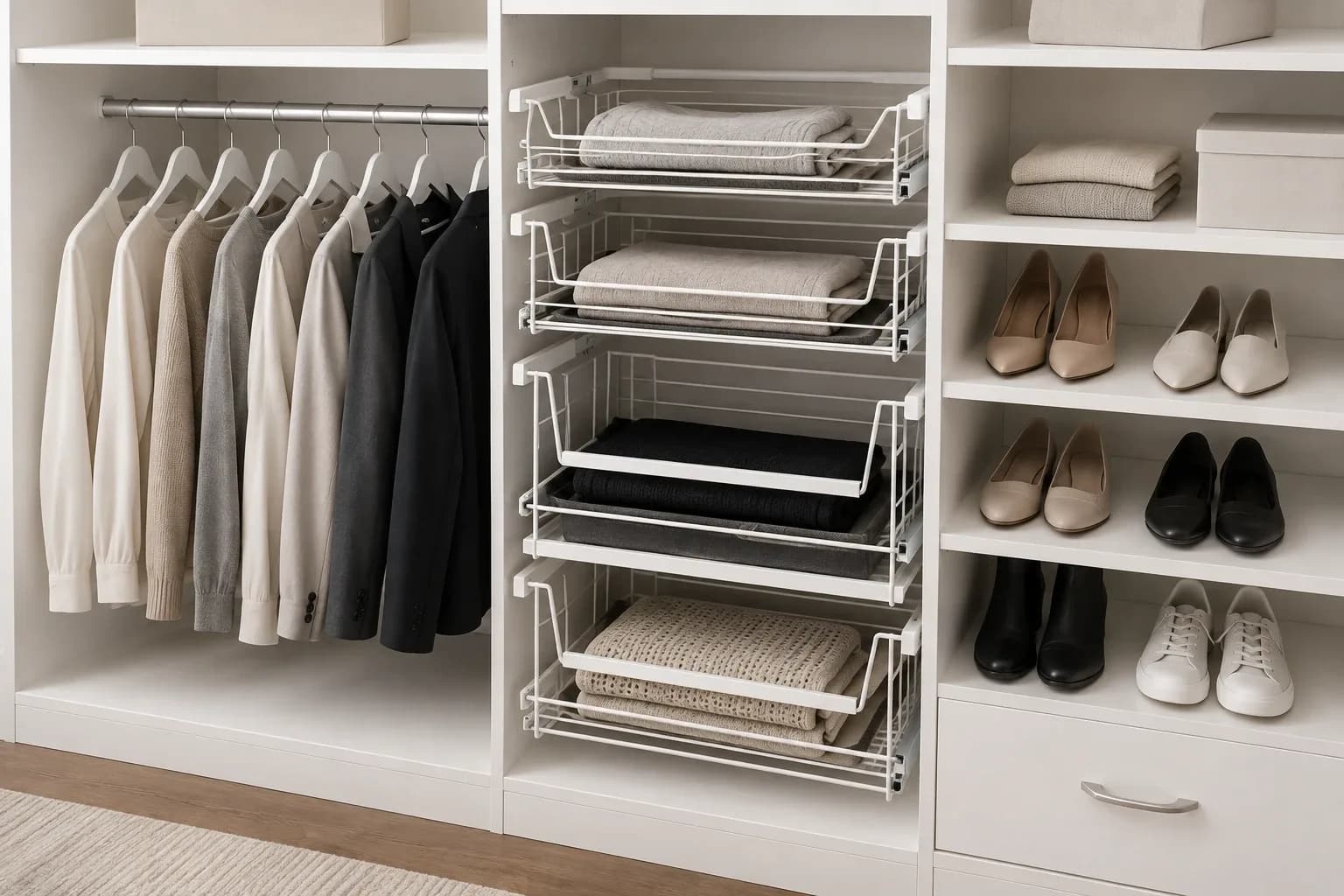
- Pull-out shelves
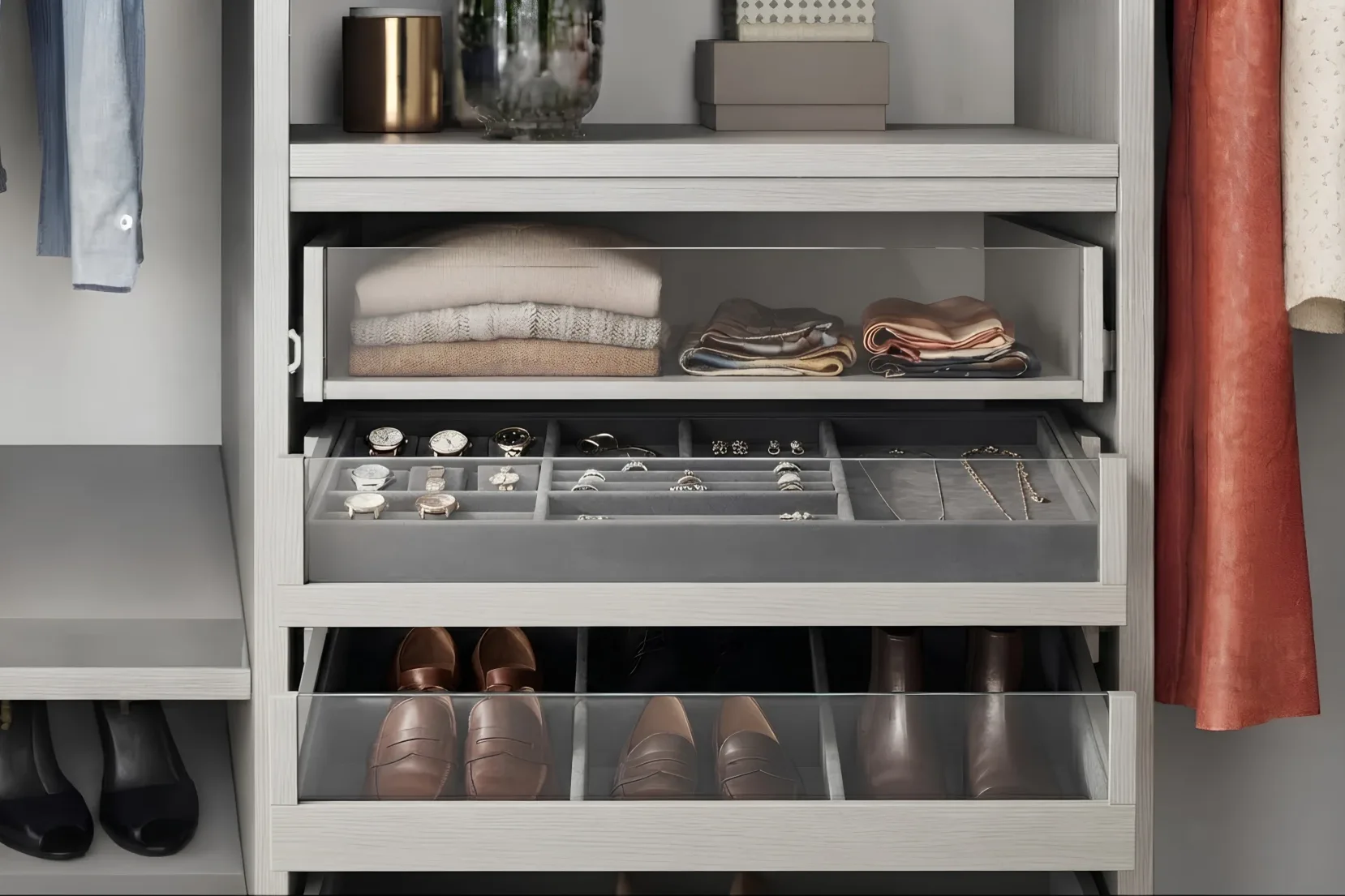
- A shelf on full-extension runners, so the back of it comes out to meet you. Knitwear stacked three deep on a fixed shelf means unstacking to reach the bottom of the pile; on a pull-out you look down at all of it at once. Fitted where folded clothes actually live rather than throughout a closet, because a pull-out costs more than a shelf and only earns that where you are digging.
- Jewellery drawer inserts
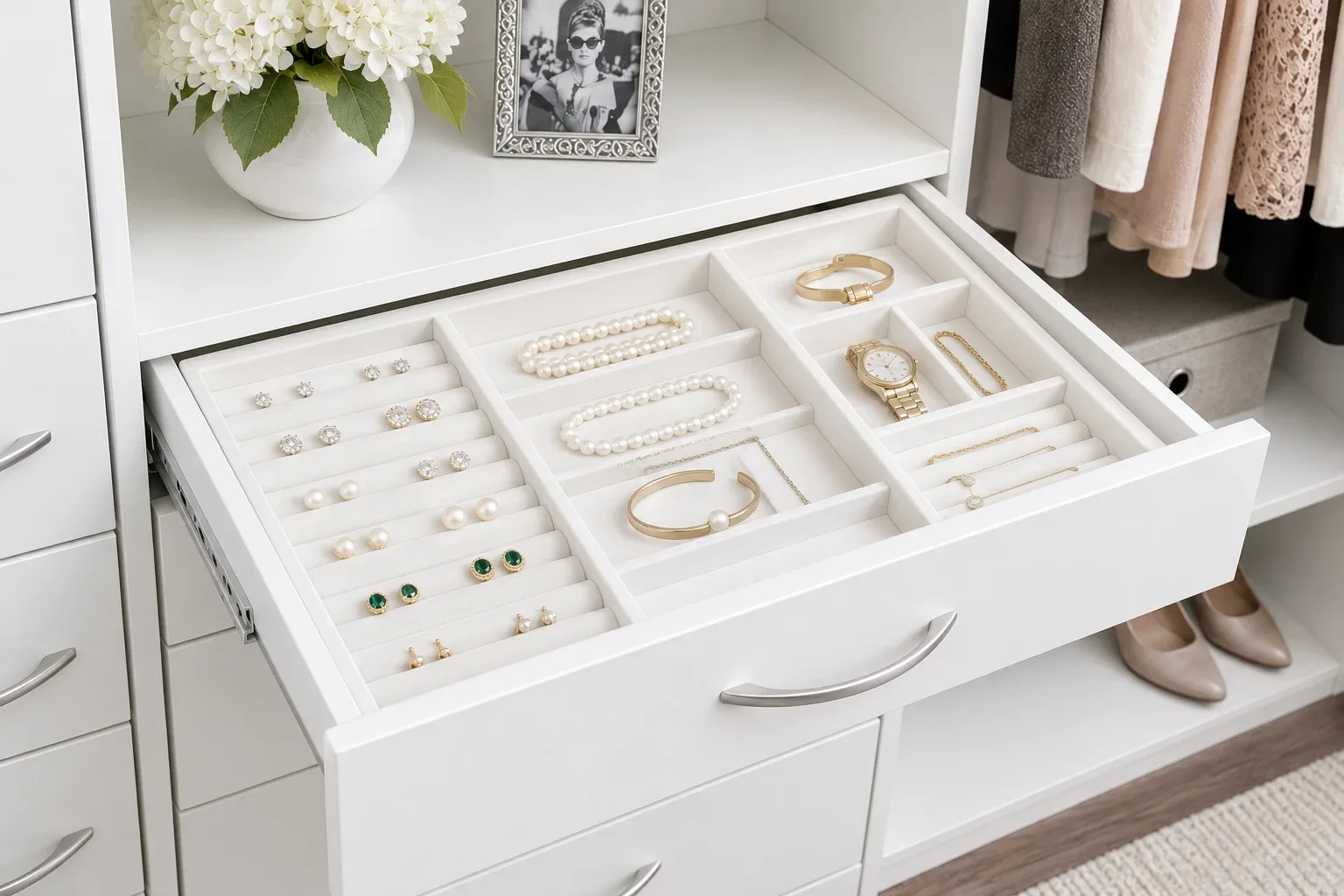
- A lined tray dropped into a standard drawer: slotted rows for earrings and rings, longer bays for necklaces, chains and a watch. It sits on the drawer bottom rather than being built into it, so the drawer is still an ordinary drawer if the collection ever changes. Sized to the drawer at the design visit, not bought to fit afterwards.
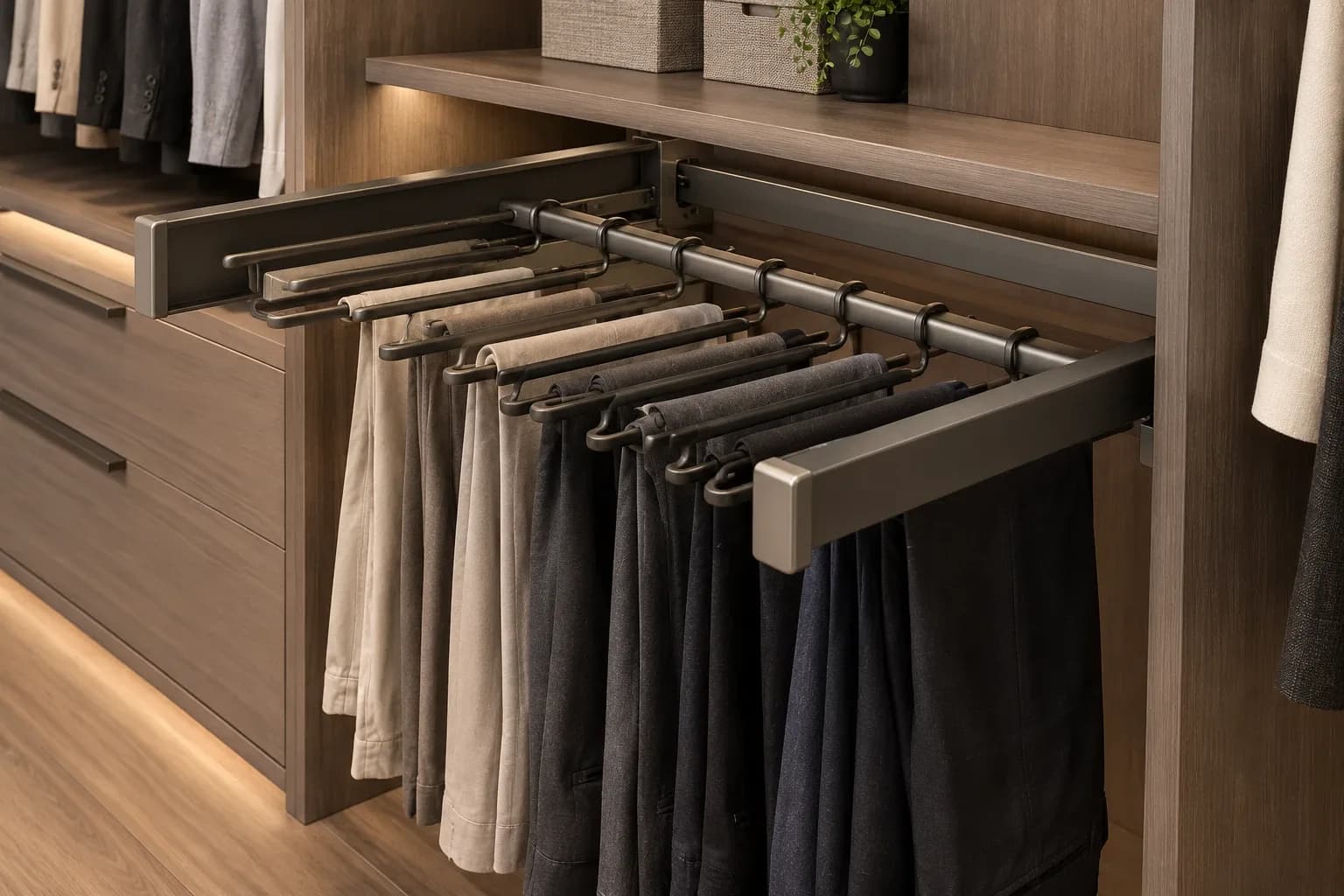
- Pull-out trouser racks
- Individual arms on a rack that slides out of the cabinet, so trousers hang full length without a crease across the knee and one pair comes out without disturbing the rest. It takes the depth of a drawer bay and gives back the hanging capacity of a section far taller than itself, which is why it earns its place in a closet short on wall.
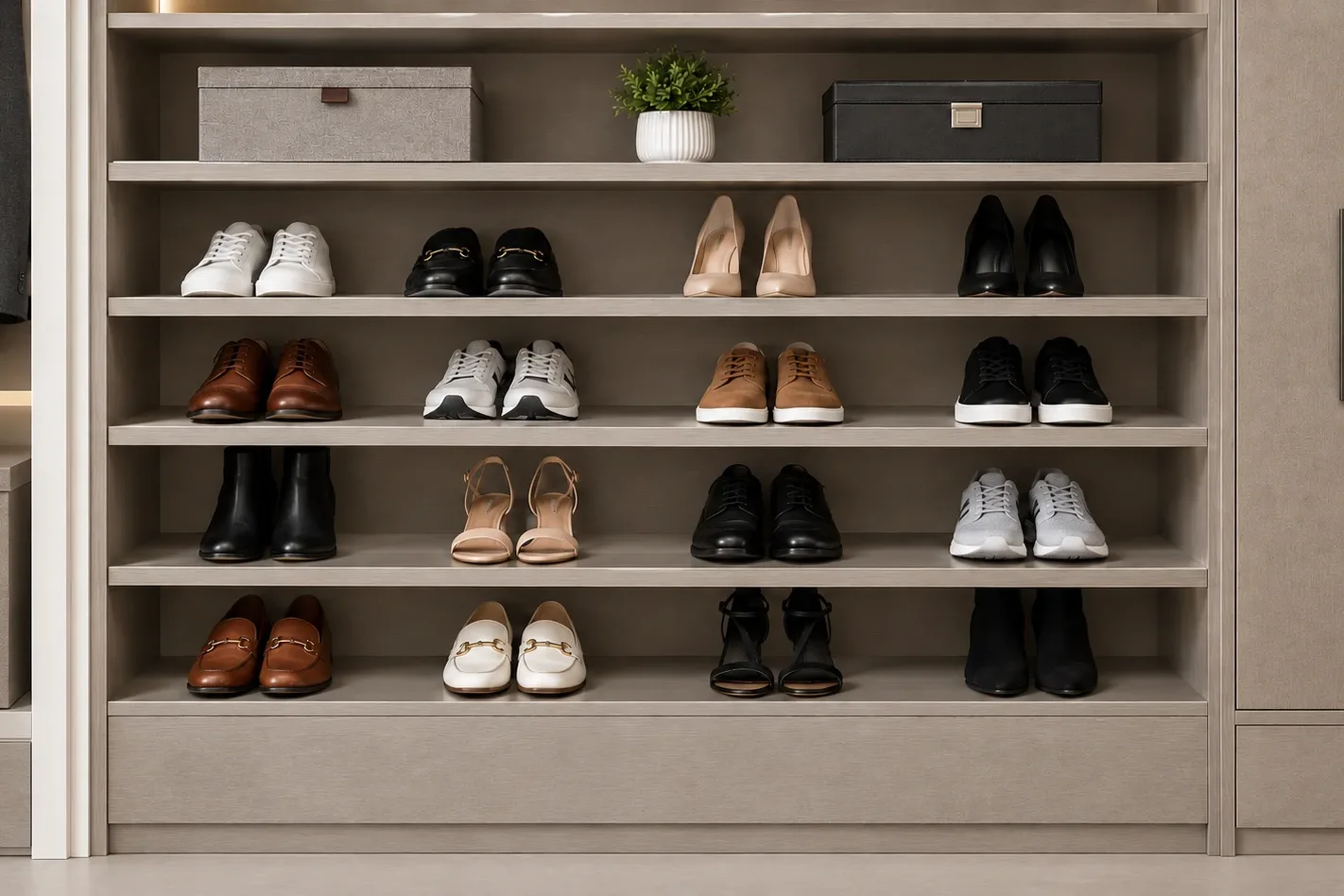
- Shoe shelving
- Shelving set at shoe pitch, which is far closer together than a folded-clothes shelf, so the same wall holds two or three times the pairs. Flat shelves take about a third more pairs per foot; angled ones present the shoe to you instead of storing it. That is a choice made per bay at the design visit rather than once for the whole closet.
- Wire pull-out baskets
- Ventilated baskets on runners, for the things that should not sit in a closed drawer — gym kit, linens, anything that goes away less than perfectly dry. You can read the contents from above without opening anything, which is why they tend to end up holding whatever gets used most.
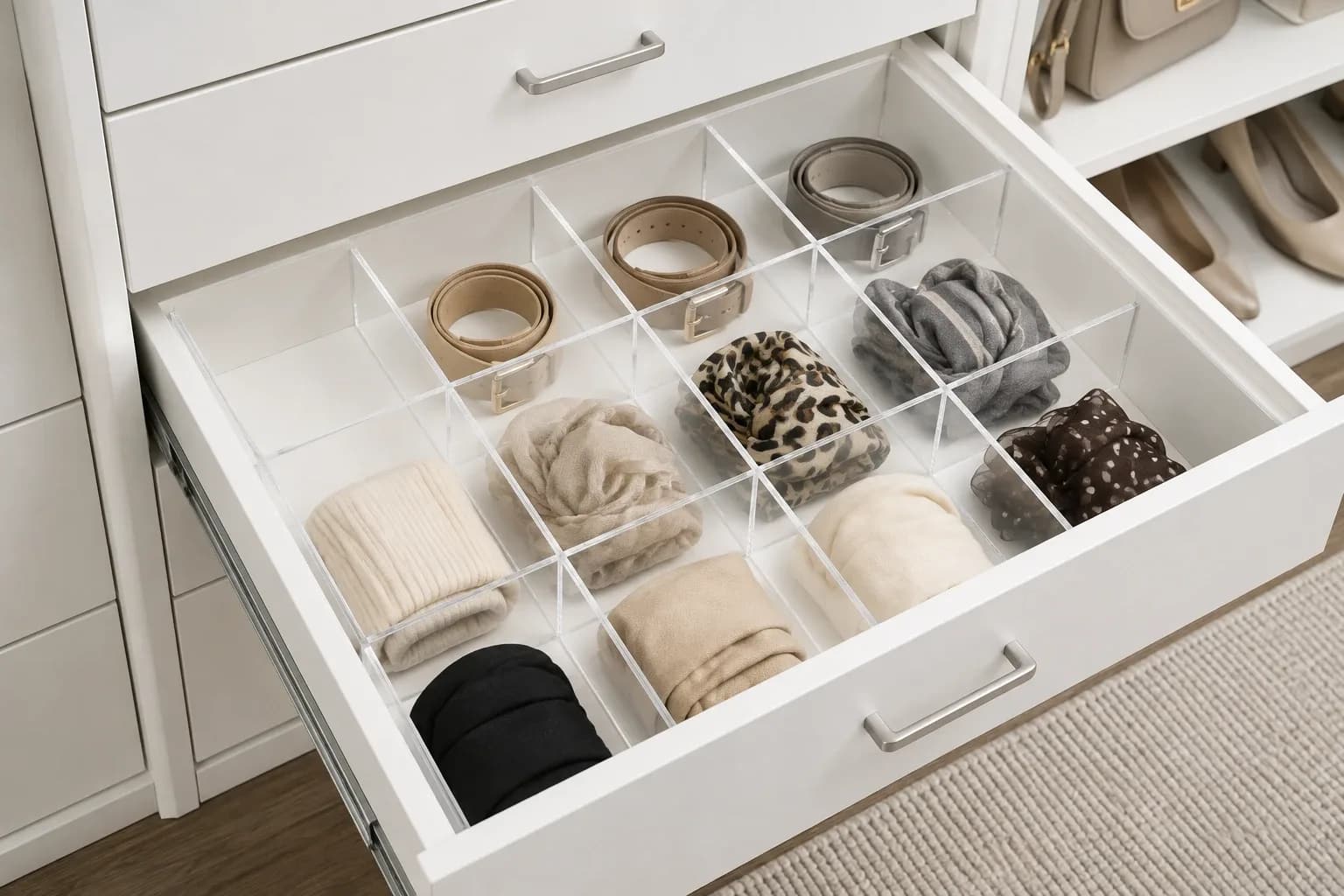
- Drawer dividers
- Clear dividers that split a drawer into a grid sized to what goes in it, rather than to whatever a catalogue had. They lift out, so a drawer laid out for belts and scarves this year can be relaid for something else next year without any joinery. The cheapest thing on this page and the one that changes a drawer most.
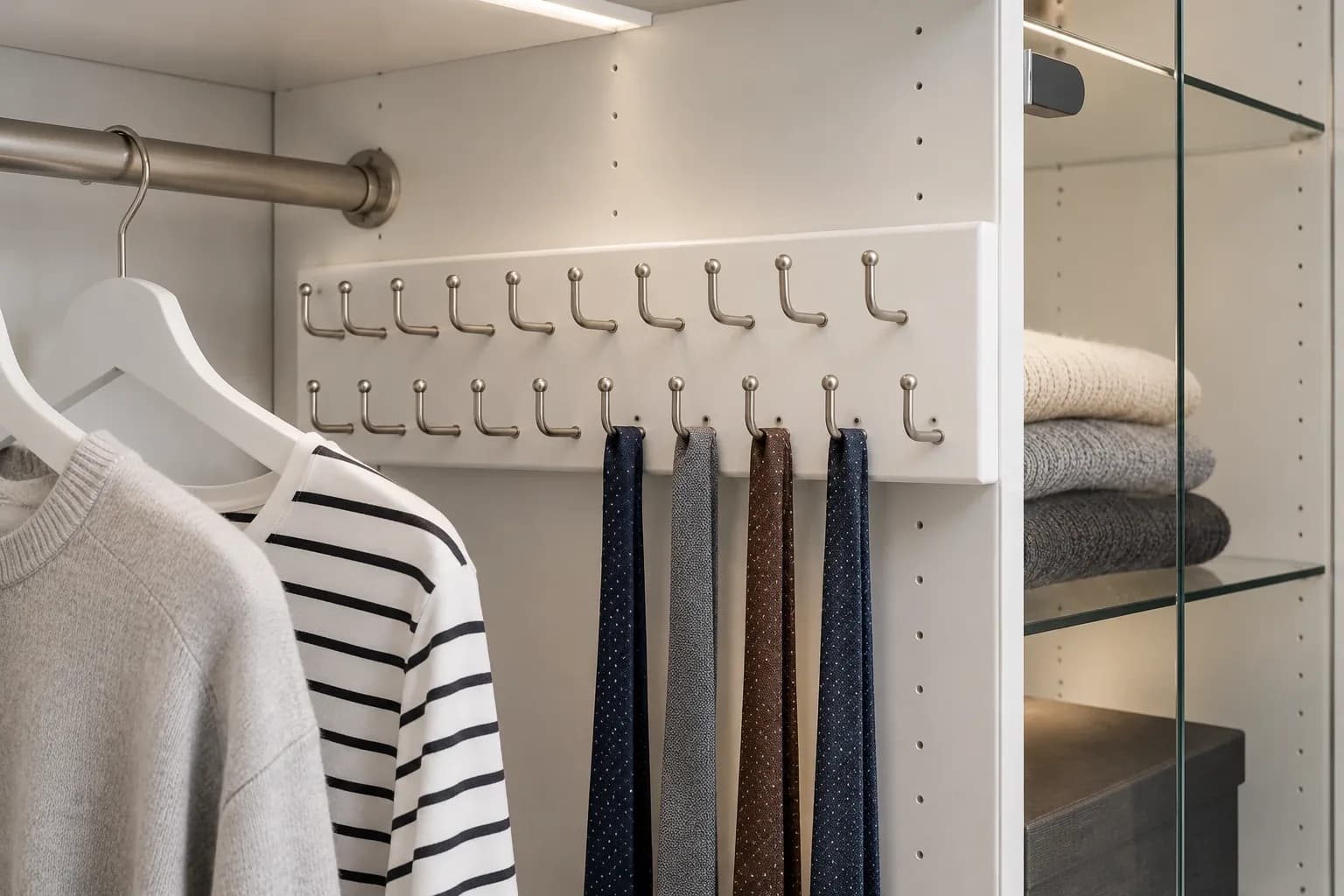
- Tie racks
- A double row of hooks on a panel inside the bay, at a height where a tie hangs clear of the shelf beneath it. Every tie is visible at once, which is the entire point of the thing — a tie you cannot see is a tie you do not wear. Mounted on a side panel, where it uses vertical space nothing else was using.
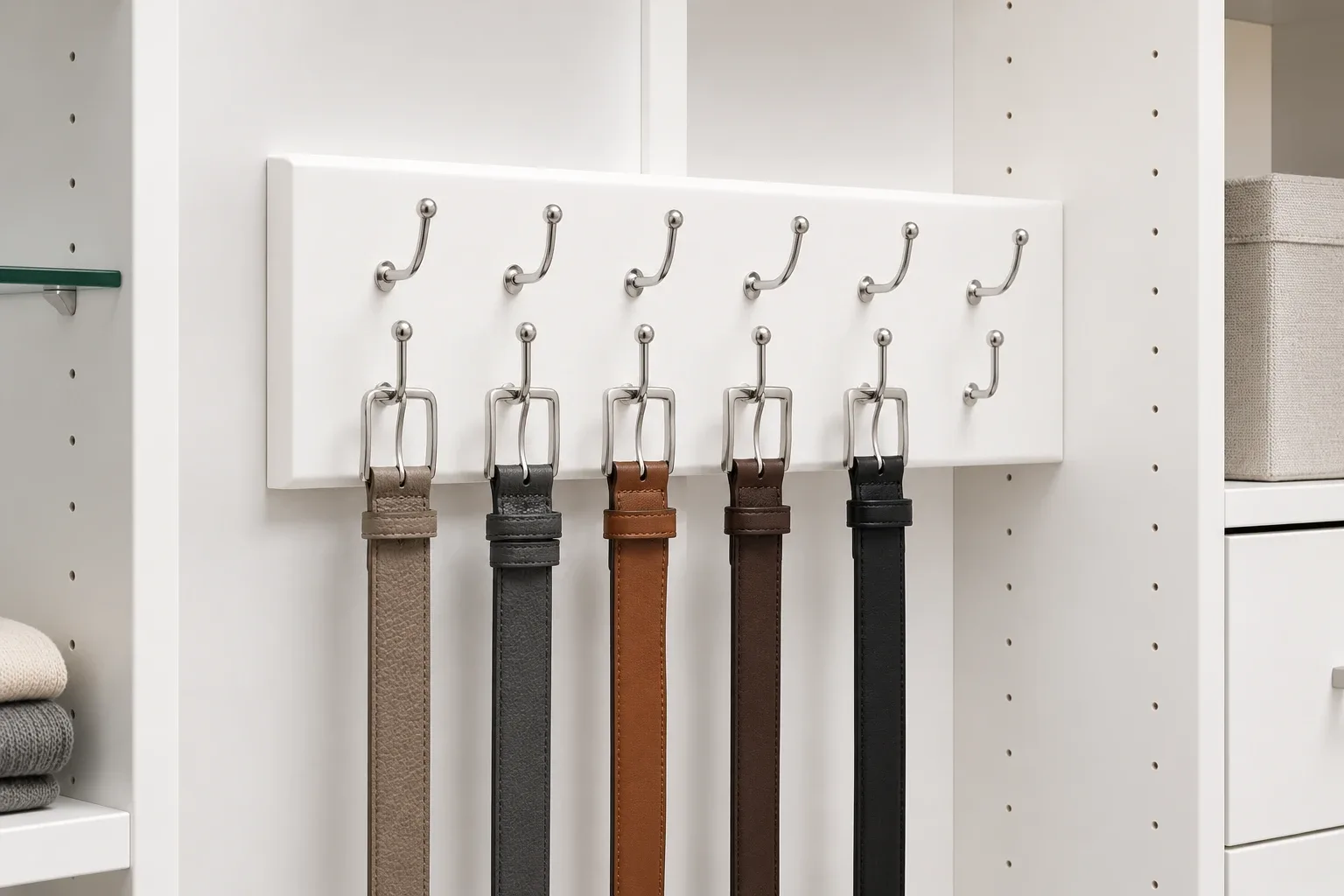
- Belt racks
- The same idea for belts, spaced for a buckle so leather is not pressed against leather along its whole length. It goes on the side of a bay or inside a door — a belt coiled in a drawer takes a drawer, and a belt over a rail slides off it.
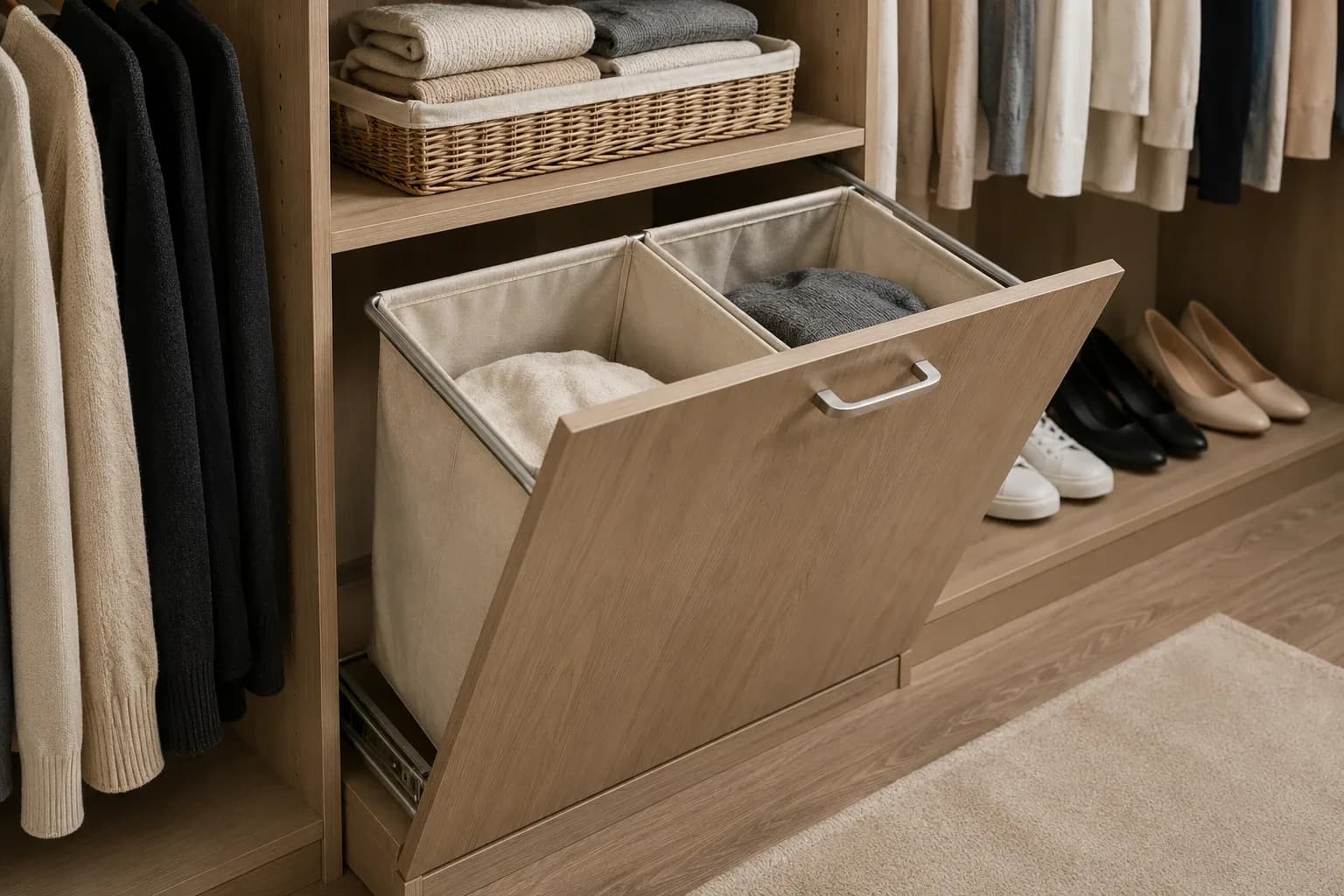
- Tilt-out hampers
- A hamper behind a cabinet front that tilts forward on the door, so laundry goes into the closet instead of into a basket on the floor beside it. Twin bags let lights and darks separate as you undress rather than on laundry day. It needs its door swing drawn in, which is why it is far easier to include now than to add later.
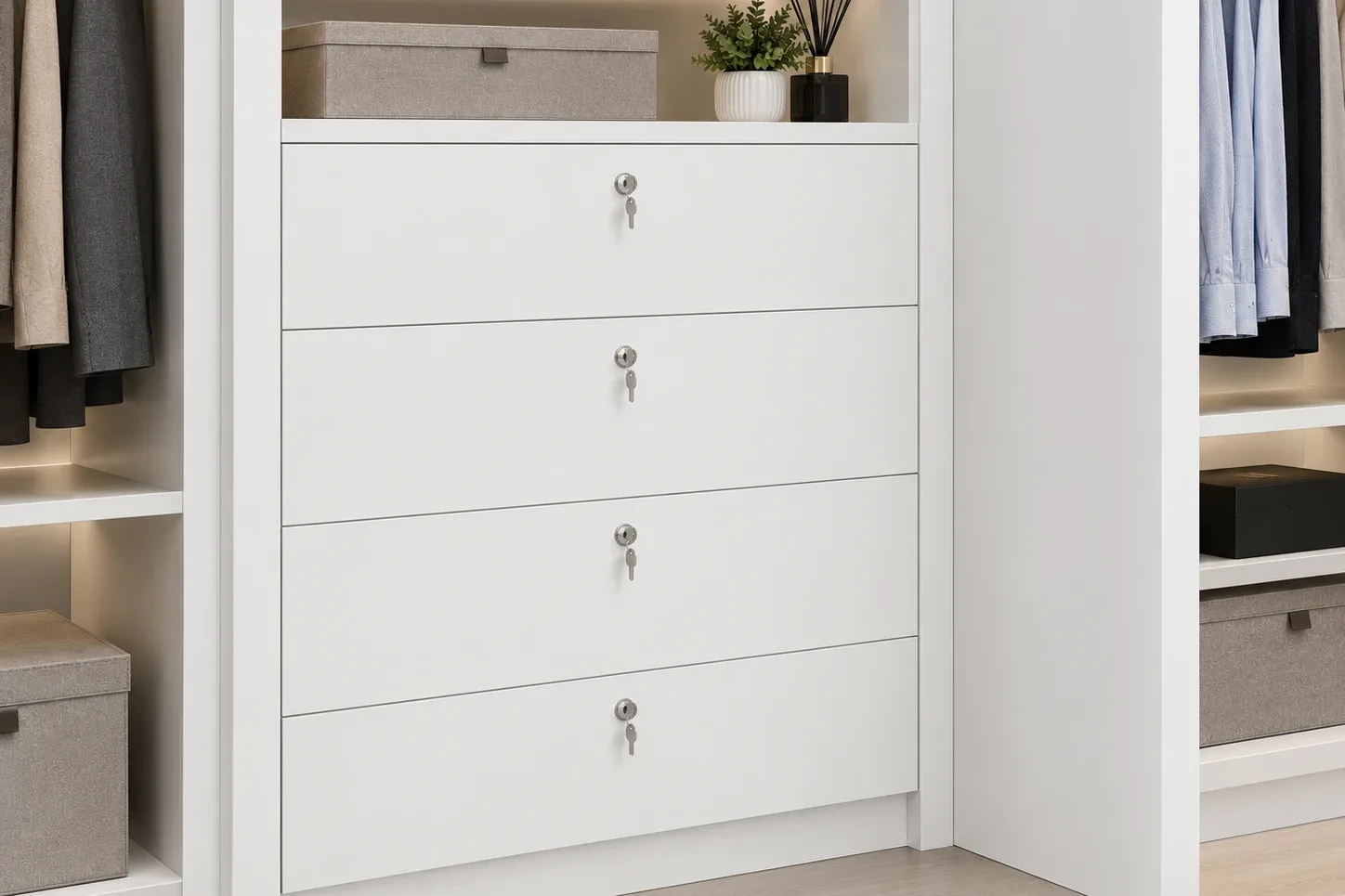
- Locking drawers
- A drawer bank with a keyed lock, built into the run so nothing about it announces what it is. It is not a safe and is not sold as one: it keeps documents, watches and medication out of reach of the people who are simply in the house, which is what most people actually want a locking drawer for.
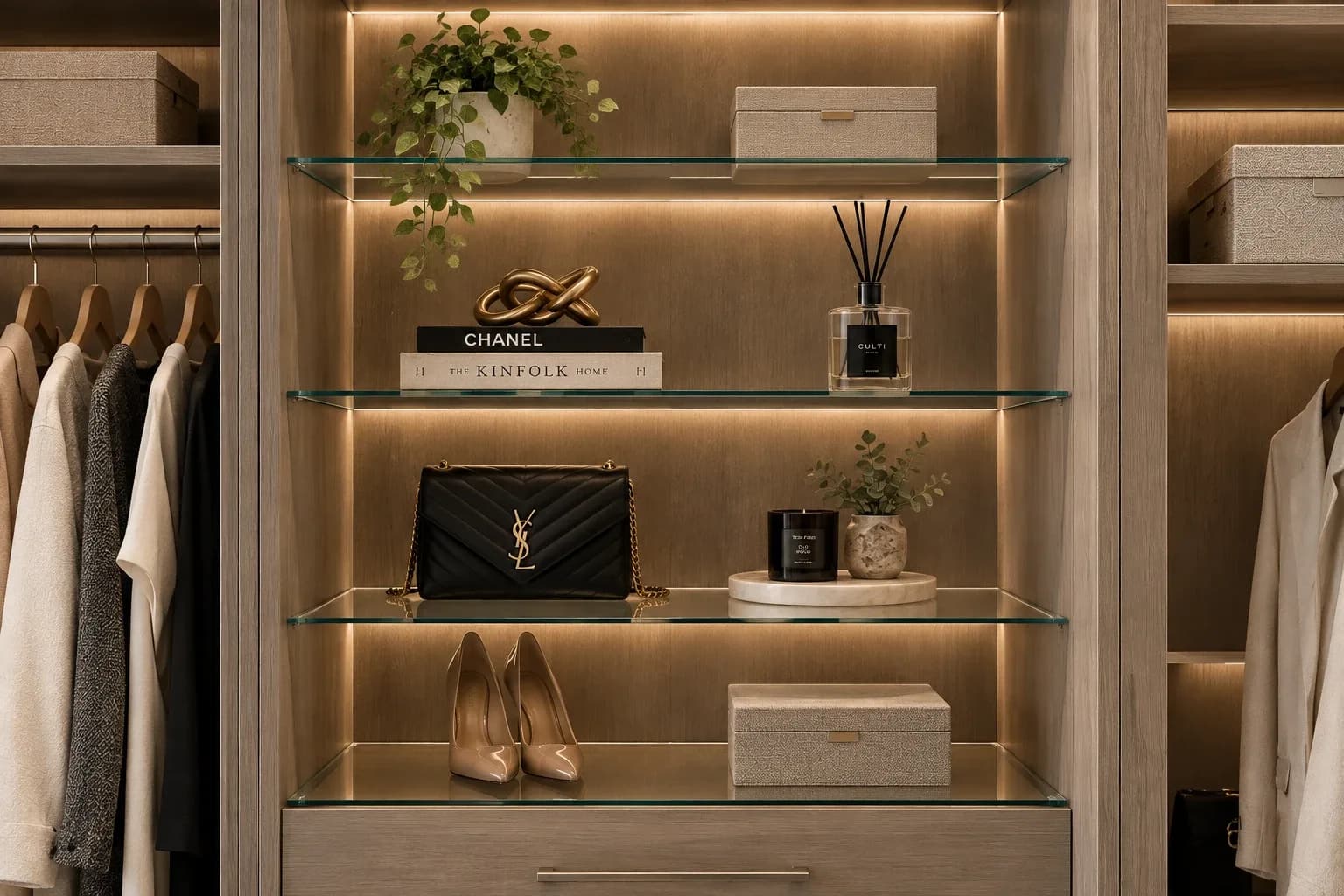
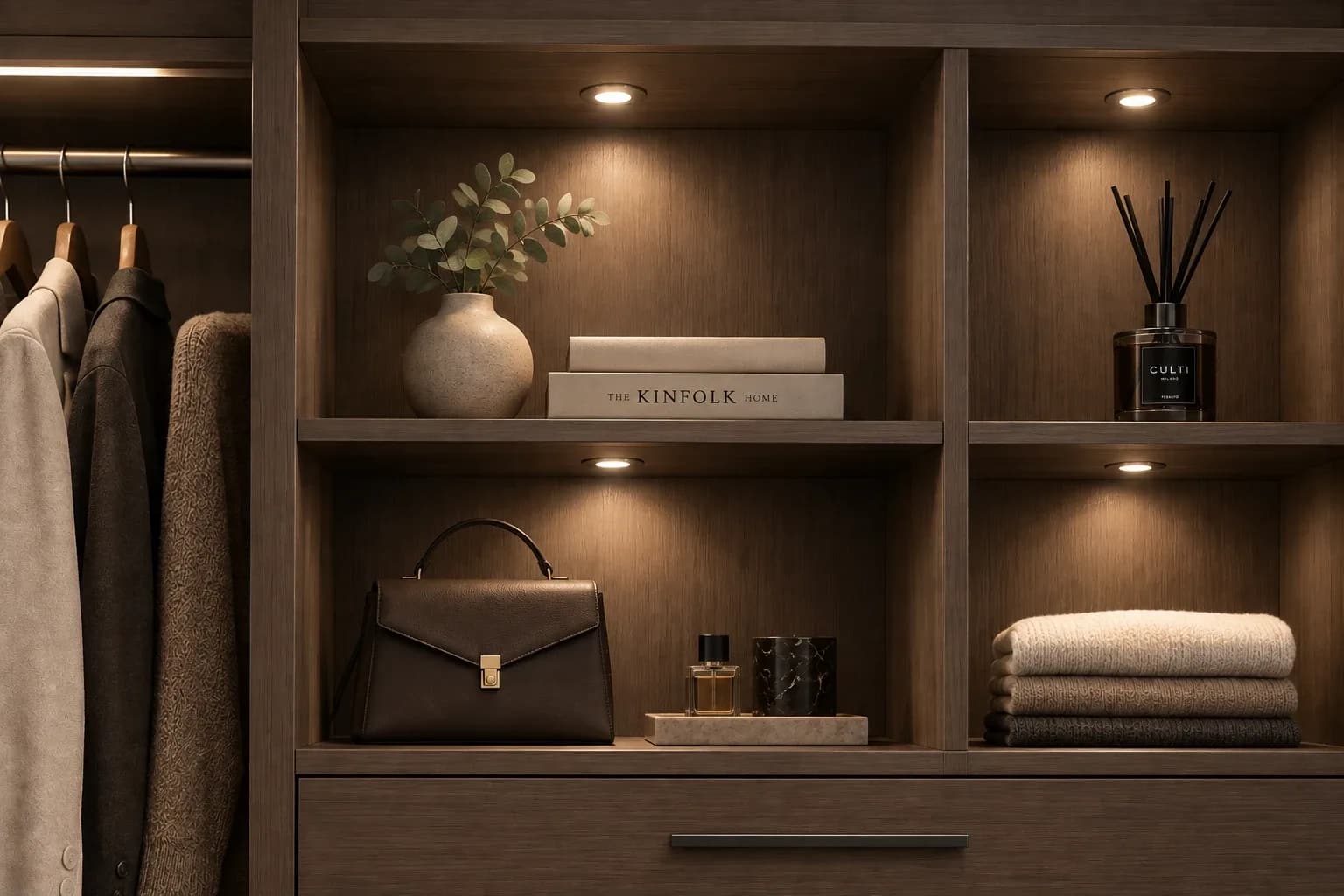
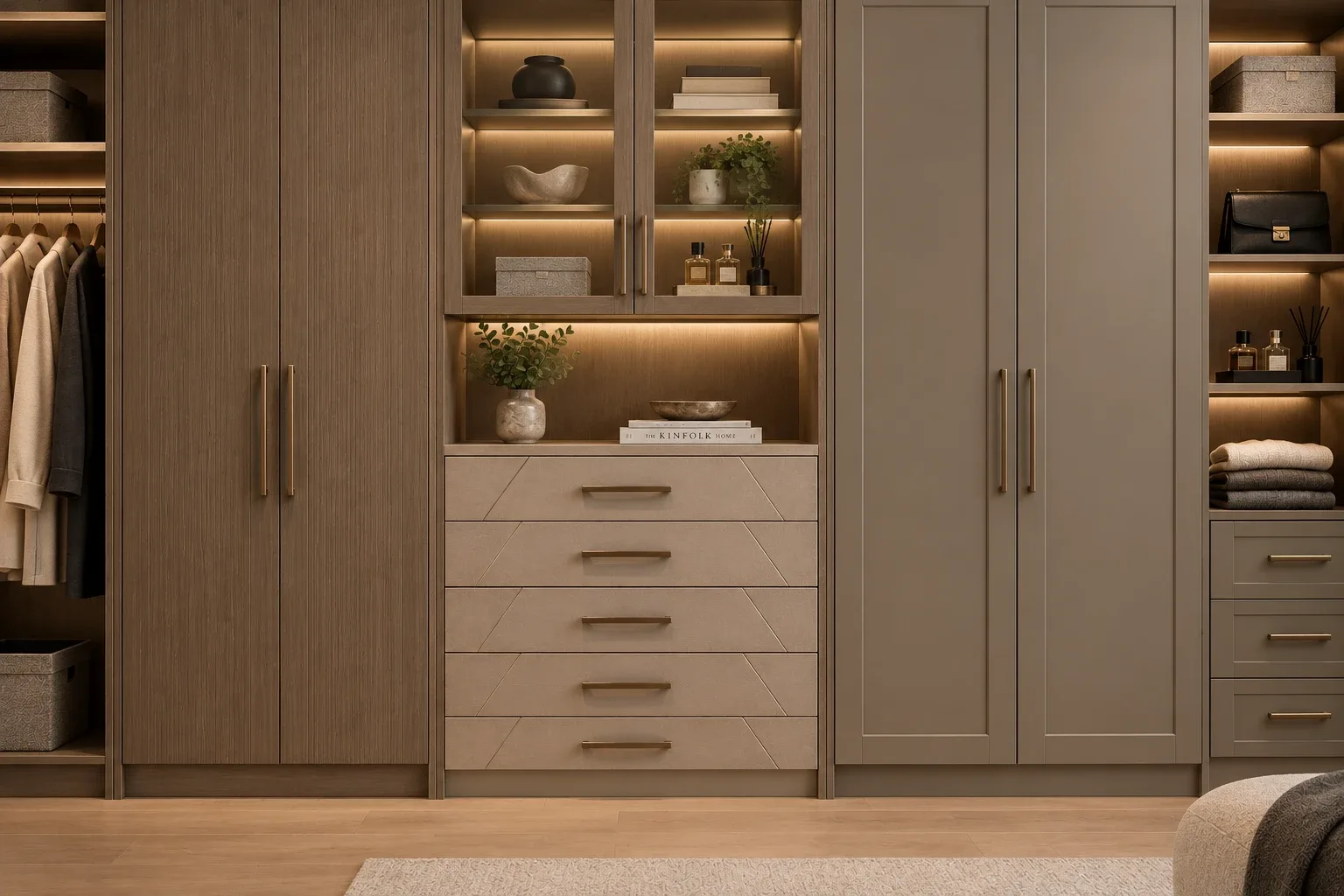
- Lit glass shelving
- Toughened glass shelves with the LED run along the front edge, so the light reaches the shelf below rather than stopping at the one above. It is the only shelving that lights the thing underneath it, which is why it belongs where handbags and shoes are displayed and not where the linen is stored.
- Integrated shelf lighting
- Downlights set into the underside of a shelf and wired into the cabinetry, aimed at the shelf below rather than into your eyes. Run on a sensor so the closet lights when the door opens, or on a switch where a sensor would be a nuisance. Typically $200 to $600 for a closet, depending on the run length and which of the two it is.
- Glass-front cabinets
- Framed glass doors on the upper cabinets, so what is inside stays visible and stays clean — which matters more in a closet than people expect, because the top shelf is where dust settles. Fitted where a display bay faces into a room you stand in, and left off where a solid door does the same job for less.
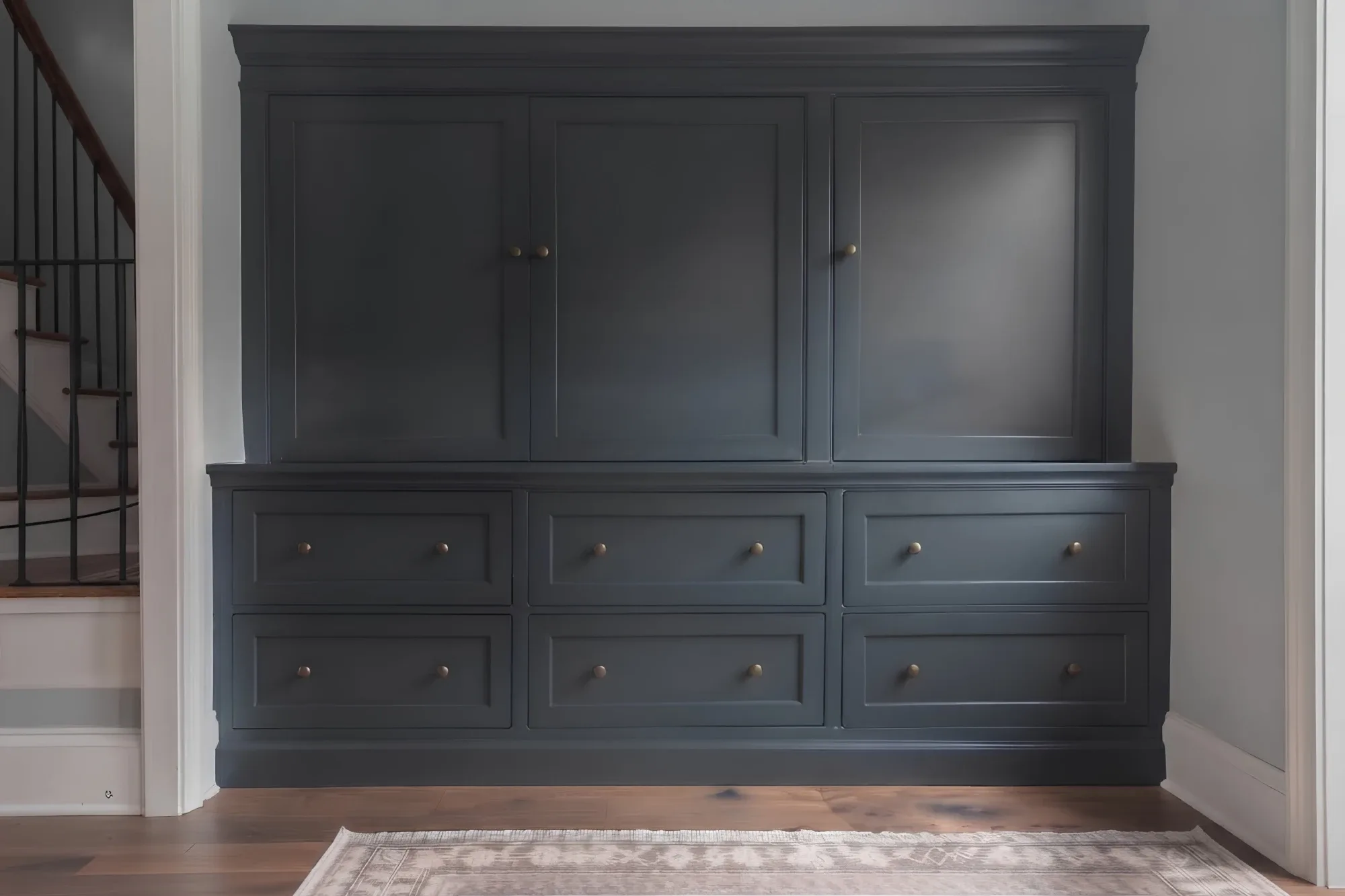
- Decorative doors and drawers
- Panelled fronts on the doors and drawers instead of plain slabs, with crown moulding at the ceiling and base moulding down to the floor. The trim is what lets a floor-to-ceiling run sit flush in an older house where no wall is quite straight. It is also the decision that moves a quote across the whole unit rather than in one place, because every opening gets a front.
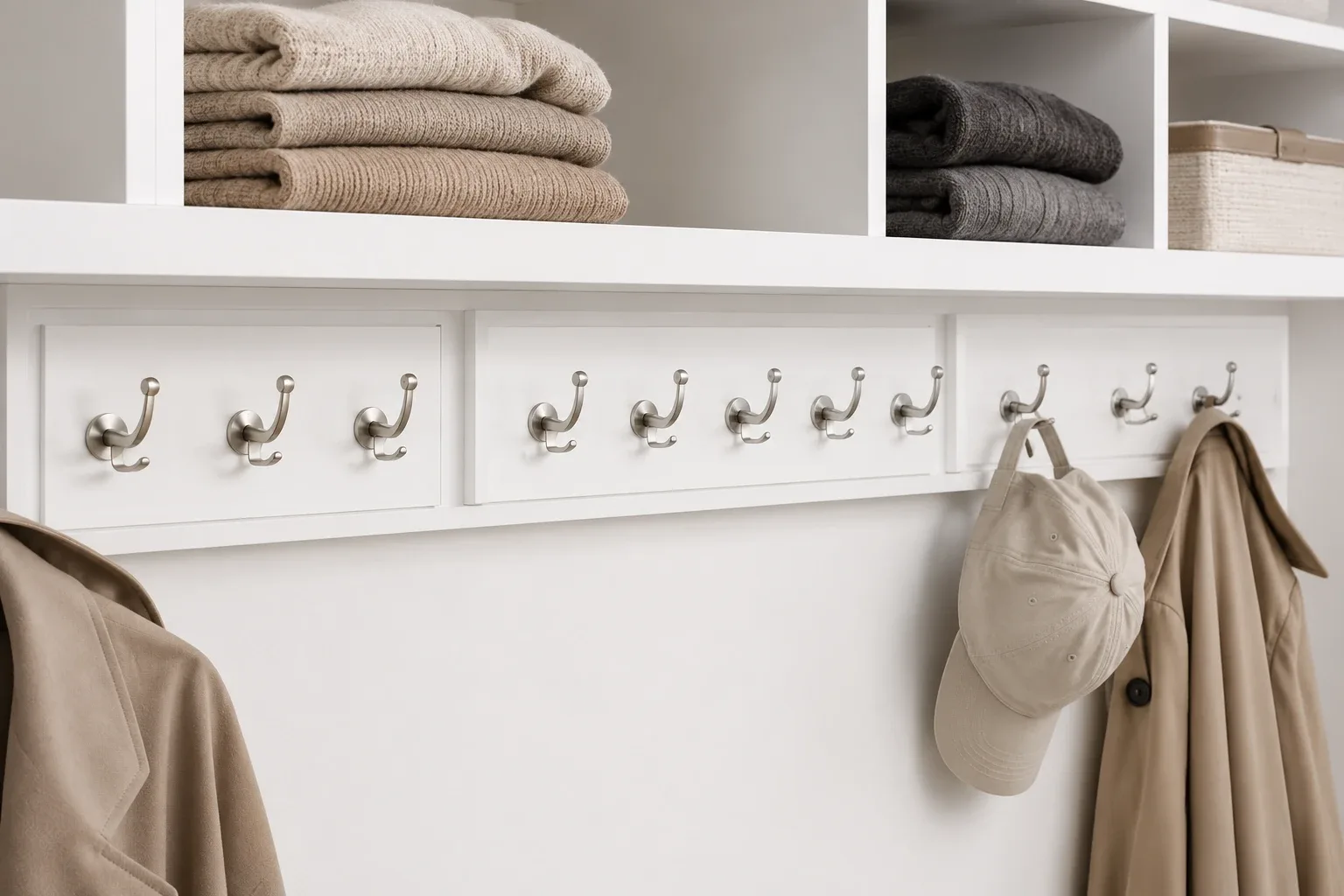
- Hook rails
- A rail of hooks on a backer panel, for the things nobody puts on a hanger — bags, caps, the coat that comes off at the door, a robe. Fitted at two heights where children use the run, and always on a backer so the drywall behind it is not what takes the weight.
Drawers & inserts
Drawers & inserts
Hanging fittings
Shoes & storage
Shoes & storage
Drawers & inserts
Hanging fittings
Hanging fittings
Shoes & storage
Drawers & inserts
Display & lighting
Display & lighting
Fronts & trim
Fronts & trim
Hanging fittings
Where to start
Which accessories to spend on first
If the list is longer than the budget, this is the order we would cut it in — least expensive and most useful at the top.
- Drawer dividers and lined inserts
- The least expensive items on the page and the ones that change a drawer most. A drawer without dividers becomes a heap within a month whatever it started as, and no amount of cabinetry fixes that. If the budget only stretches to one thing, it is this.
- Shoe shelving at the right pitch
- Shoes are the single biggest cause of floor clutter in a closet, and the fix is shelving spaced for shoes rather than a shelf that happens to have shoes on it. It costs little more than ordinary shelving because it is ordinary shelving, set closer together.
- Integrated lighting
- A closet you cannot see into gets used badly no matter how well it is fitted, and this is the upgrade people mention unprompted afterwards. It has to be wired in as the cabinetry is built, so it is also the one that is genuinely awkward to add later.
- Pull-out shelves and trouser racks
- These earn their place where you are digging — the folded stack you unstack every morning, the trousers that crease over a rail. Worth fitting in one or two bays rather than throughout, which is how the cost stays sensible.
- Display fittings — glass fronts and lit glass shelves
- The most expensive per foot and the last to justify on function alone, because they change how a closet looks rather than what it holds. Genuinely worth it in a dressing room you stand in; hard to defend inside a door you keep shut.
Questions
Closet accessory questions, answered
Pull-out shelves, drawer dividers, lined jewellery inserts, locking drawers, pull-out trouser racks, tie and belt racks, hook rails, shoe shelving, ventilated wire baskets, tilt-out laundry hampers, integrated shelf lighting, lit glass shelving, glass-front cabinets, and decorative panelled doors and drawer fronts with crown and base moulding. Valet rods, pull-down hanging rails and pull-out mirrors are fitted too. Each is a separate line on your quote rather than part of a package.
It depends entirely on which ones, which is why they are itemised rather than bundled. As published figures: a four-drawer bank on soft-close undermount runners is typically $600 to $1,200 depending on width and front, LED lighting is typically $200 to $600 for a closet, and an island — the largest accessory there is — starts around $2,500. Smaller fittings such as dividers, tie and belt racks are modest on their own and add up quickly together.
They are included in the figure you are quoted, because they are drawn and priced before you approve anything. What we do not do is quote the cabinetry, get the deposit, and then price the accessories separately. Every item appears as its own line on the itemised quote, so if the total is over what you wanted, you can take items out and watch the number come down at your kitchen table.
Sometimes, and your designer will say honestly at the visit. Some items — dividers, lined inserts, hook rails — drop into most cabinetry. Others need the bay sized around them: a trouser rack needs its depth, a tilt-out hamper needs its door swing, and lit glass shelving needs a cable route that a finished closet does not have. Retro-fitting those usually means losing a shelf.
A valet rod is a short bar that pulls straight out at eye level, for hanging tomorrow's outfit or a shirt fresh from the press — it holds a few hangers for a few hours. A pull-down rail is a full hanging rail on an arm that brings a high section down within reach, so the space above head height becomes usable storage rather than a shelf you need a stool for. Different jobs: one is a staging post, the other is capacity.
Yes, roughly a third fewer pairs per foot. Angled shelving presents the shoe to you rather than storing it, so it is a choice between display and capacity. Most closets end up with both — angled where the closet is seen from the bedroom, flat where the wall is doing the work.
No, and we will not describe it as one. It is a cabinet drawer with a keyed lock, built in so nothing about it draws attention. It is meant to keep documents, watches and medication out of casual reach inside your own home. Anything that needs to resist a determined attempt belongs in a real safe.
No. A reach-in benefits more from some of them, not less — a pull-down rail, a pull-out trouser rack and shoe shelving at the right pitch are how a five-foot opening holds what it holds. What a reach-in cannot take is anything needing floor in the middle of the room, which is the island and the bench. Wardrobes and condo closets sit in between.
Reviews
What Toronto clients say
Rated 5.0 on Google
- Didar ParharAugust 2026Very happy with the work done by the team. Very responsive from the initial call, fair and reasonable quote, and happy with the end result. Highly recommend
- Khachig MinassianAugust 2026Really happy with how our walk-in closet turned out. Closet Form did a great job with the design and installation. They made good use of the space, and everything looks clean, simple, and well organized. The whole process was smooth, and the team was professional and easy to work with. We're very happy with the final result and would definitely recommend Closet Form to anyone looking for a custom closet.
- Hadi AL HaddadJuly 2026Closet form one of the best closet company in GTA they are very professional, very honest, reasonable price, very punctual. I highly recommend them for all your closet needs. Thx guys for taking care about my business
- K. VijayJune 2026I can't recommend this team enough. Marco handled the design and communication quickly and professionally, and then Daniel came in with great attention to detail and made sure everything met my expectations. These two are reliable, easy to work with, and very reasonably priced. I actually insisted on writing this review—it wasn't even requested. I'm beyond happy with the quality of the work and the price. I wouldn't hesitate to recommend them to anyone.
- Misbaah BhattiJune 2026I just had 6 rooms in my house done by closetform and they did an amazing job! Everyone was super punctual, and professional. They had great communication and I love how everything turned out. They took into consideration any changes I wanted and were very thorough with planning. I would recommend this team.
Next step
Book the free in-home visit.
Thirty to forty-five minutes, laser measurements, a 3D design and an itemized price. No deposit, no obligation.
- Call or text
- (647) 561-9874
- info@closetform.ca
- Hours
- Mon–Fri 8:00 AM – 6:00 PM
Sat 9:00 AM – 5:00 PM - Where we work
- Toronto & the GTA
Evening appointments